Skip to content
Lean Skipper Cap. Système. Maîtrise.
The 20-point checklist

Recreational boatbuilders

The know-how in two heads, nothing written down, a shop floor in firefighting mode.

In boatbuilding, almost nobody trains team leaders in shop-floor management. I come and do it, at your yard, for 90 days: I train, I coach, and I leave behind an operating system to run the shop floor. No CAPEX.

  1. Cap.Thirty days to see the remaining work.
  2. Système.Know-how written down, flow on takt.
  3. Maîtrise.Your front-line managers run it without me.

Scroll

Start light

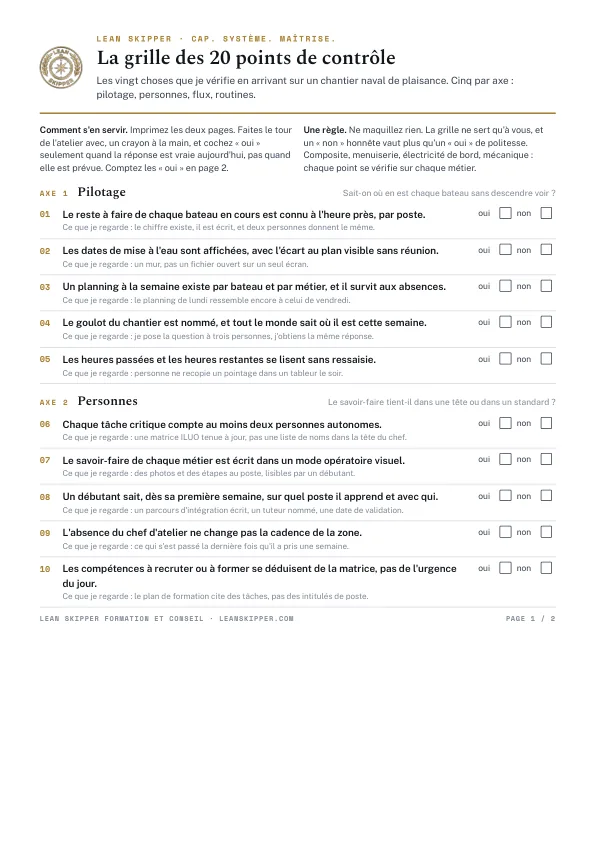
The twenty points I check when I walk into a yard

Five per axis: steering, people, flow, routines. Two pages to print and tick off as you walk the shop floor. The count of "yes" answers tells you where you stand straight away, no meeting and no pitch.

By leaving your address, you agree that Lean Skipper may write to you about the checklist. No data is ever sold.

Prefer a number on where you stand? The 6-question diagnostic, three minutes, instant score.

First page of the Lean Skipper twenty-point checklist
Two pages, A4 format, to tick off in pencil

Lean Skipper is the brand under which Tiago Mance works as an interim manager, specialized in industrializing recreational boatbuilders. He writes down the know-how of the trades, composites, joinery, marine electrical and mechanical, gets the assembly flow back on takt and trains the front-line managers, in 90 days and without CAPEX. A single practitioner, equipped with AI and with the OS Lean Skipper, his industry-specific operating system, produces the deliverables himself on the shop floor. The legal entity is Lean Skipper Formation et Conseil, in France. Tiago Mance also runs Hybdor Marine Power Train, the electric and hybrid marine propulsion brand of Espadarte Indústria e Comércio, in Brazil: what he deploys at his clients, he runs at home.

Who it's for
Recreational boatbuilders and marine SMEs with EUR 5 to 50 million in revenue
Duration
90 days, in three phases: Cap, Système, Maîtrise
Where
Europe and the Americas
Languages
French, English, Portuguese. Spanish and Italian with assistance.
The problem

A single cause behind the dates that slip

"My best laminator is retiring. The joiner has just had a baby. The mechanic is off sick. The electrician has just resigned. And I can't find anyone." What I hear in meetings, condensed into one voice

This is not a recruiting problem. It's concentrated know-how, never written down, and a shop floor nobody runs.

  1. 01

    Dependence

    The know-how sits in two or three heads. When one is missing, the pace drops with it.

    My laminator left for the competitor. We lost three months of output.
  2. 02

    Nothing written down

    No standard, no work instruction, no visible remaining work. Every boat is rebuilt from memory, and the new hire learns by watching.

    In two years he leaves, and I have nobody to take over.
  3. 03

    Nobody runs the shop floor

    The team leader firefights, he doesn't manage. The pace is negotiated every morning, depending on who is in.

    Every morning I redo the schedule depending on who is in.

Shop-floor management can be learned. Yet there is very little training or coaching for it in industry, and almost none in boatbuilding. The methods are known; what's missing is someone who comes and installs them with your front-line managers.

The answer

A turnkey solution, on site

  1. Trainyour team leaders, supervisors and shop managers, at the workstation, to hold a standard and run a huddle.
  2. Coach90 days on the shop floor, until the routine holds without me.
  3. Leave an OSa shop-floor management toolbox, the OS Lean Skipper, to industrialize the process.
"Investing before structuring is automating waste." Tiago Mance, founder of Lean Skipper
The method

Ninety days, three phases

I don't deliver a report. I take the helm until the system runs without me, and without you.

Days 0 to 30

Cap

Diagnosis and trajectory

Before accelerating, set the trajectory. Cap diagnoses what ails the yard and puts numbers on the delivery targets.

  • Diagnosis: bottlenecks, limiting beliefs, cash tied up in hulls.
  • Alignment: launch targets agreed with management, in days.
  • Roadmap: a quantified trajectory, no CAPEX, committed in front of the management committee.

Goal: stop the drifting and chart the way out.

Days 30 to 60

Système

Know-how written down, flow on takt

The OS Lean Skipper, the operating system designed for recreational boatbuilding: people, process, useful technology.

  • Every task described in ten dimensions: tools, safety, duration, skill, standard, bill of materials, quality, work instruction, lead time, pacing.
  • Every trade standardized, skills on an ILUO matrix.
  • The flow: boatside kitting, takt time, remaining work visible with no double entry.

Goal: make flow automatic.

Days 60 to 90

Maîtrise

Execution and handover

My difference: I execute. On the shop floor, alongside the craftsmen, until the routine holds without me.

  • Action on the shop floor, station by station.
  • Routines made visual, and daily Gemba walks.
  • Coaching for foremen and shop managers.

Goal: performance that survives departures.

01 · DescribeEvery task in ten dimensions. That is the building block: a task can only be managed if everything it needs is written down.
02 · StandardizeThe trade stops being a personal talent. It becomes a visual work instruction that can be learned.
03 · MeasureThe ILUO matrix says who knows what, to what level, and who can train. An area holds if every critical task has two autonomous people.
04 · TransferTraining happens at the workstation, not in a classroom. Skill is seen and checked, and the beginner knows from week one where they are learning and with whom.

What it changes: a beginner becomes autonomous at a workstation in a few weeks rather than years. Turnover no longer breaks the pace, and you run your production instead of negotiating it every morning.

Industry-specific operating system

OS Lean Skipper

An operating system designed for recreational boatbuilders, not a reconfigured generic ERP. I'm Tiago Mance: I run it alone, with AI agents.

A consultancy bills audit days and leaves a report. The report describes a method, and the method waits for someone to apply it. In a yard with a full order book, that someone doesn't exist: the two or three heads who know are already taken by production.

I work as a "high individual contributor", a single practitioner who produces the deliverables himself instead of coordinating a team. The OS holds the mission plan, the standards being written and the remaining work at each station. The agents absorb what repeats: writing up the routings, tracking the gaps between two walks through the shop. AI takes the share of the work that gets done at a desk. My presence on the shop floor is undiminished, and the shop floor and the decisions stay with me.

I call this Service as a Software: the yard buys a result, not software to keep alive. By day 90, it keeps its standards, its remaining work and its routines, and they run without me. A 90-day project and coaching engagement from EUR 2,450 excluding VAT, no CAPEX.
To see the OS up close, a demonstration mock-up: the operators' ticket board, the phone view, the stockroom and what the system works out on its own.

See the OS demo
Who it's for

I don't work with everyone

Saying no quickly saves time for both of us. Here is the line.

It's for you if

  • You build boats, or you supply those who do.
  • Your revenue is between EUR 5 and 50 million, and it grows by more than 10% a year.
  • Your order book is full and your dates still slip.
  • One or two key people carry the know-how, and you know it.
  • You want a visible return in under a year rather than a study.

It's not for you if

  • You are looking for a report to present, with no intention of changing the shop floor.
  • You already have an in-house operational excellence department.
  • Your order book is empty: the problem is commercial before it is industrial.
  • You want the practitioner to stay indefinitely.
The proof

What people who have worked with me say

A client boatbuilder, then six public recommendations, quoted word for word.

HanseYachts AG Greifswald, Germany · Łozienica, Poland
"Thanks to your input, we'll have now a few "To-Dos", looking forward to seeing them turn into reality. Our Managing Director liked your results and suggestions." Alexander Busher, Lean Manager, HanseYachts AG

Industrial maturity assessment and kaizen event at both sites, with Daniel Kuhn, Head of Industrial Engineering. HanseYachts describes itself as the world's second-largest sailboat builder.

"Tiago has very strong Lean Manufacturing skills and is particularly good at passing on and explaining Lean concepts and tools. He teaches with clarity and pragmatism, which makes the concepts easier for the teams to understand and take ownership of. His ability to connect Lean principles to concrete shop-floor problems is a real asset."
Nicolas De OliveiraProduction Manager, Republic Technologies France
"I had the chance to work with Tiago on Lean Management training courses when I was HR Director at Righini. Beyond his expertise, I particularly appreciated his curiosity, his keen understanding of business issues and his ability to broaden perspectives."
Lauriane GonzalezHR Director, then at Righini
« Garante cada projeto seja único e não apenas uma lista de tarefas a serem cumpridas, mas uma jornada estruturada rumo ao sucesso. Você é uma referência para mim. »

He makes sure every project is unique, not just a list of tasks to tick off but a structured journey toward success. You are a role model for me.

Leandro Küster WolffNational Director of Continuous Improvement and Training, Castel Groupe Angola
« Aprendi muito com o Tiago quando trabalhei com ele na implantação do lean manufacturing em um estaleiro de lanchas de grande porte. Tiago é um profundo conhecedor de todas as ferramentas da gestão industrial estratégica para maximizar a produtividade e reduzir as perdas. »

I learned a lot from Tiago when I worked with him implementing lean manufacturing at a builder of large motor yachts. Tiago has deep knowledge of every tool of strategic industrial management for maximizing productivity and reducing losses.

André Felipe Gomes de AndradeMaintenance, Production and Engineering Manager, TPM and Lean Manufacturing; he reported to Tiago
"Beyond already being a great professional in recreational boatbuilding, Tiago brings his unique human qualities of enthusiasm, integrity, adaptability and confidence in the future, which allow him to lead difficult transformation projects with a sensitivity and people skills that let him rally teams around ambitious challenges."
Loïc GélébartConsultant
"Tiago is a very competent person, it was a pleasure to work with him on the same project. His lean culture and analytical mind are fascinating. Beyond his hard skills, he is an inspiring leader with very good interpersonal skills who knows how to lead a project team to achieve ambitious objectives."
Houssam ElamriProduction Director, Smurfit Westrock; he reported to Tiago

Recommendations published on Tiago Mance's LinkedIn profile.

Twenty years in boatbuildingIncluding opening a factory in Brazil and an M&A deal in Portugal
Ten countriesFrance, Brazil, Poland, Germany, Italy, Portugal, United States, Ireland, Estonia, Finland
Hybdor Marine Power TrainFounder and CEO of Espadarte, electric and hybrid marine propulsion
TrainerYellow Belt and Green Belt, INEMA Albi, IAE
AuthorLe Protocole du Leader, a structured method inspired by Lean
The six-question diagnostic

Where does your yard stand?

Three minutes. The score shows straight away, before you are asked for anything. You can then keep the score and the first action to take by email, with the link to book 45 minutes if you want to talk it through.

  1. 01 You answer the six questions. No sign-up.
  2. 02 You see your score and your four axes, then you keep them by email.
  3. 03 The message carries the link to book 45 minutes, at a time that suits you.
Understand before you buy

Le Protocole du Leader

Cover of the book Le Protocole du Leader, by Tiago Mance

The method exists outside of me, and that is the point. The first chapter is free to read: the origin of the LAPIS method, what a pencil did during the space race, and the foundations of the protocol. The full book comes with a practice tool, the GPS LAPIS, whose demo is open to everyone.

What it costs

The order of magnitude, right away

I work like a boutique: each mission is priced for your yard, with a return on investment committed in the proposal. To give you an idea:

A 90-day project and coaching engagement starts at EUR 2,450 excluding VAT.

The final amount depends on the size of the yard and the number of areas. The twenty-point checklist and the six-question diagnostic are free, no meeting required.

What I get asked
What is an interim manager for a boatyard?

An interim manager takes operational responsibility for production for a set period, here 90 days. He decides, executes on the shop floor and answers for the result. A consultant delivers a report; an interim manager delivers a yard that runs. Here, that role is mine: I'm Tiago Mance, and I hold it.

What does "no CAPEX" mean?

No machine, no building and no heavy software is bought during the mission. Capacity comes from flow: know-how written down, boatside kitting, takt time, ILUO matrix, waiting eliminated. A yard recovers capacity it already pays for and loses in walking around, in searching for parts and in rework.

You work with AI: what does that change for my yard?

Running the shop floor generates data every day: remaining work, missing parts, disruptions, skills. My AI agents keep it up to date and prepare the morning's decisions, in the OS Lean Skipper, my industry-specific operating system. The time saved goes to the shop floor. You have no software to buy or administer: the service is delivered, and what stays human doesn't change: the Gemba, the coaching of front-line managers, the decision in front of the management committee.

We've already done Lean, it didn't stick. Why would this time be different?

A standard that doesn't stick is a standard nobody runs. The Maîtrise phase, from day 60 to day 90, exists for that: I coach the front-line managers on the shop floor until the routine runs without me.

Our boats are one-offs. Isn't Lean for series production?

The building block of the OS Lean Skipper is not the product, it's the task, described in ten dimensions. Takt time applies to the assembly, not to the model. A yard building one-offs has the same waiting, the same missing parts and the same dependence on its key people as a series builder.

Another consultant?

I run Hybdor Marine Power Train, my own marine propulsion brand, built by Espadarte in Brazil. What I deploy at your yard, I run at home. And I have a direct interest in your yard growing: it's my market too.

We need to invest in a machine first.

Investing before structuring is automating waste. Let's measure real capacity first. If the machine is still needed afterwards, it will be for the right reasons, and it will run in a flow that feeds it.

Do you work outside France?

Yes. I work in Europe and the Americas, in French, English and Portuguese; in Spanish and Italian with assistance. My recent missions include a yard in Germany and Poland.

Logbook

The weekly update

One report from the shop floor a week: a real bottleneck, the measure taken, the result. No theory, no advertising.

Subscribe on LinkedIn

Weekly publication, one-click subscription, no email to leave.

Station by station

What happens, concretely, at the ten stations

At each station, the OS, the manager and me. Scroll: the boat is built from gelcoat to delivery.

Station 01 of 10

Gelcoat

The OS
Writes up the standard dictated at the mold: thickness, gel time, release time.
The manager
The team leader enforces the standard at the station, at every mold.
Tiago
I measure it at the mold with the laminator, and I train the team leader to hold it.

Set your course

Start with what commits you least

The checklist reads in ten minutes and asks only for an email address. The diagnostic takes three minutes and gives you a score. The meeting comes after, if you want it. And if you would rather write first, a message on LinkedIn is enough: I listen to the need, and I tell you whether I can be useful.

Scroll: the boat is built station by station

Two missions, in practice

How we find the lever, and how we make the change stick

Two yards, unnamed. The need as it was expressed, what was done, the lever we found, and what made the change hold after I left.

Yard A

A production sailboat builder, two manufacturing sites in Europe

Situation
Two production sites in two countries, one shared industrial engineering team, series production running.
Problem
Two sites, two ways of working: what is written down at one lives in people's heads at the other, and no common measure of their industrial maturity.
Implication
Management allocates improvement efforts site by site, by feel, and one site's good practices never reach the other.
Stated need
An industrial maturity assessment at both sites, and concrete actions at the end of it, not a report.
How it went
The assessment carried out on the shop floor, at each site, with the head of industrial engineering: what is written down, what sits in people's heads, where the flow breaks. Then a kaizen event at each site, with the teams, on the gaps found.
The lever
Boil the assessment down to a short list of actions, each with an owner, rather than a report. That list is what top management kept.
Change management
The actions are carried by the yard's industrial engineering, not by me: what remains after the mission belongs to those who stay.

What the client took away: a short list of actions to carry out, approved by its top management along with the recommendations.

Yard B

A catamaran builder in France

Situation
One-off production, production supervisors who run the shop floor, boats that go to the port for finishing and delivery.
Problem
Each boat's remaining work is neither written down nor passed on: it lives in the supervisor's head.
Implication
What is left to finish gets discovered at the port, and the supervisor cannot see at a glance what is in front of him.
Stated need
Autonomous supervisors to manage each boat's remaining work, and boats that leave better finished.
How it went
Coaching the production supervisors, on the shop floor, boat by boat: each unit's remaining work written down, kept up to date by the supervisor, and passed on to the port with the boat.
The lever
Make the remaining work visible and have it owned by the person who keeps the board every day. A boat whose remaining work is known comes out better finished.
Change management
No tool imposed from above: the supervisor builds their remaining work with me, until they are comfortable on their own. The routine is theirs when I leave.

What the client took away: every boat leaves with a real remaining-work list, passed on to the port, and the boats come out better finished; the supervisor is more at ease and sees what he has to do.